Nasrallah renews warning to Israel, says Hezbollah not behind al-Hajj's case
by Naharnet Newsdesk over 3 years
Timeline
Nasrallah: We in Hezbollah have not started discussing the presidential candidates yet and we will not have a candidate but will rather decide whom to support among the natural candidates.
over 3 years
Nasrallah: The transfer of money from occupied Palestine to Lebanon is an outlawed action regardless of its reasons.
over 3 years
Nasrallah: What happened over the past two days over Archbishop’s al-Hajj case will not keep a state, institutions or a judiciary and it is a dangerous course.
over 3 years
Nasrallah: I tell all Lebanese people, especially Christians, that Hezbollah has nothing to do at all with Archbishop al-Hajj's case.
over 3 years
Nasrallah: Hezbollah knew of the archbishop's case from the media.
over 3 years
Nasrallah on al-Hajj's case: We have opted to remain silent.
over 3 years
Nasrallah on Archbishop al-Hajj's case: The Lebanese security agencies do not work at Hezbollah's instructions. There is a law in Lebanon and security agencies address everything related to collaboration with Israel.
over 3 years
Nasrallah: We have not asked anyone to join a future war on our side but it is not known if other forces might join such a war and this is a strong probability.
over 3 years
Nasrallah: No one wishes for war and the decision is in Israel's hands, not in our hands.
over 3 years
Nasrallah: I tell the Lebanese people that they should be confident in the resistance's capabilities.
over 3 years
Nasrallah: Our drones entered and returned from the Galilee and occupied Palestine dozens of times over the past years and the enemy failed to shoot them down.
over 3 years
Nasrallah on Bassil's remarks: I'm ready to bring free Iranian fuel for the Lebanese power plants if the Lebanese government agrees to this, but unfortunately there is no political courage in Lebanon for such a step, because they fear U.S. sanctions on individuals and their families.
over 3 years
Nasrallah: If the extraction of oil and gas from Karish begins in September before Lebanon obtains its right, we would be heading to "a problem" and we'll do anything to achieve our objective.
over 3 years
Nasrallah: The ball now is not in Lebanon's court, because it is the party barred from extracting oil and gas in the undisputed area, and what's needed is to abide by the limits demanded by the Lebanese state and to lift the veto off the companies that will extract the oil.
over 3 years
Nasrallah: Such an action, whether in Karish or beyond, is hinging on the Israeli enemy's decision along with the U.S., and the Lebanese state offered a major concession in what it demanded through the U.S. mediator when it spoke of Line 23+.
over 3 years
Nasrallah: All fields are under threat, not only Karish, and no Israeli target at sea or on land is out of the reach of the resistance's precision missiles.
over 3 years
Nasrallah: The U.S. president does not want a war in the region and this is a chance for us to press to get our oil.
over 3 years
Nasrallah: There has been safety and security in Lebanon since 2006 due to the balance of deterrence.
over 3 years
Nasrallah: From 2006 until now, the Israeli enemy has been very careful.
over 3 years
Nasrallah: Due to the July War, the enemy realized that confrontations with the resistance became dangerous and would reach central Israel.
over 3 years
Nasrallah: The April 1996 agreement paved the way for the 2000 victory.
over 3 years
Nasrallah: High deterrence occurred between 1993 and 1996.
over 3 years
Nasrallah: I cannot forget the children whose heads were chopped by the shelling of Lahad's forces in Sidon and Nabatiyeh.
over 3 years
Nasrallah: The third phase of deterrence started in 1993.
over 3 years
Nasrallah: The second phase of deterrence started after 1985, when the enemy faced very fierce resistance whenever it tried to advance into a certain area.
over 3 years
Nasrallah: Deterrence started when the enemy realized that it cannot enter into a Lebanese region and stay in it.
over 3 years
Nasrallah: The beginnings of deterrence started in 1985, when the enemy withdrew from several Lebanese regions due to a host of military operations.
over 3 years
Nasrallah: Prior to 1982, nothing deterred the Israeli enemy from invading Lebanon.
over 3 years
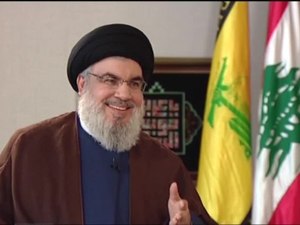
Hezbollah chief Sayyed Hassan Nasrallah warned Israel anew on Monday that it would not be able to extract gas from the Karish field without a sea border agreement with Lebanon.
“If the extraction of oil and gas from Karish begins in September before Lebanon obtains its right, we would be heading to ‘a problem’ and we'll do anything to achieve our objective,” Nasrallah said in an interview on al-Mayadeen TV.
“No one wishes for war and the decision is in Israel's hands, not in our hands,” he said.
“The U.S. president does not want a war in the region and this is a chance for us to press to get our oil,” Nasrallah added.
He again warned Israel that “all fields are under threat, not only Karish,” adding that “no Israeli target at sea or on land is out of the reach of the resistance's precision missiles.”
“Such an action, whether in Karish or beyond, is hinging on the Israeli enemy's decision along with the U.S., and the Lebanese state offered a major concession in what it demanded through the U.S. mediator when it spoke of Line 23+,” Nasrallah said.
“The ball now is not in Lebanon's court, because it is the party barred from extracting oil and gas in the undisputed area, and what's needed is to abide by the limits demanded by the Lebanese state and to lift the veto off the companies that will extract the oil,” he added.
Asked whether Hezbollah has the ability to win a future war with Israel, Nasrallah said: “I tell the Lebanese people that they should be confident in the resistance's capabilities.”
“We have not asked anyone to join a future war on our side but it is not known if other forces might join such a war and this is a strong probability,” he added.
Asked about the controversy over General Security’s interrogation and search of Archbishop Moussa al-Hajj upon his return from Israel to Lebanon, Nasrallah emphasized that “the Lebanese security agencies do not work at Hezbollah's instructions.”
“There is a law in Lebanon and security agencies address everything related to collaboration with Israel,” he noted.
“Hezbollah knew of the archbishop's case from the media,” Nasrallah pointed out.
“I tell all Lebanese people, especially Christians, that Hezbollah has nothing to do at all with Archbishop al-Hajj's case,” he said.
Warning that “what happened over the past two days over Archbishop’s al-Hajj case will not keep a state, institutions or a judiciary,” Nasrallah noted that “the transfer of money from occupied Palestine to Lebanon is an outlawed action regardless of its reasons.”
"Judge (Fadi) Akiki is being accused of treason because he ordered General Security to search the archbishop's suitcases, and today the marginalization of security agencies and the judiciary is being practiced by those who objected against us when we spoke of the port blast incident," Nasrallah added.
As for the upcoming presidential election in Lebanon, Nasrallah said: “We in Hezbollah have not started discussing the presidential candidates yet and we will not have a candidate but will rather decide whom to support among the natural candidates.”

 over 3 years
 over 3 years
God bless Hezbollah chief Sayyed Hassan Nasrallah. You are the pulse of our hearts, the light in our eyes, and the crown on our heads.
Shia Shea Shia !!!