
France orders 4,000 more evacuated as heat threatens fragile hold on vast wildfire
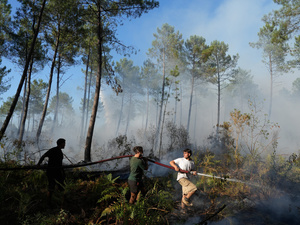
French authorities ordered nearly 4,000 people evacuated Tuesday from tourist sites on the Atlantic coast as returning heat threatened firefighters' fragile hold on a vast wildfire west of Bordeaux.
The new evacuations deepened a wildfire emergency of exceptional scale across southwestern Europe. Fires in France and Spain have forced roughly 330,000 people to evacuate, while Spain entered its fourth heat wave of the summer with several blazes still out of control, including its largest on record.
Firefighters had held the French blaze in check through a calm night, bringing flare-ups near coastal dunes under control and keeping the burned area unchanged at 420 square kilometers (162 square miles).
Authorities described the Gironde fire as stabilized, not fixed — meaning it could still spread again as temperatures rose and humidity fell.
The precautionary evacuation order covered campsites, holiday villages, tourist residences and leisure parks around the resort of Lacanau, including Lacanau Ocean and both shores of Lacanau lake, Gironde regional authorities said.
"We are at a point of fragility," Eric Brocardi, spokesperson for France's national firefighters federation, told BFMTV on Tuesday. "We will continue attacking this fire despite the forecast rise in temperatures."
The blaze, raging since last week, has been wildly unpredictable, transforming at times into a self-feeding firestorm as it burned through an area four times the size of Paris and forced 220,000 people to evacuate homes and vacation accommodation.
Even after 24 hours without further advance, officials warned that smoldering vegetation, rising temperatures and falling humidity could produce fresh outbreaks along the vast perimeter.
Firefighters and military engineers resumed work early Tuesday on tactical firebreaks designed to prevent the flames from spreading. Authorities said 103 kilometers (64 miles) of firebreaks had been completed.
Ninety-three firefighters have been injured while battling the blaze, the prefecture said.
The A63 highway remained partly closed, while rail traffic south of Bordeaux was suspended except on the route toward Toulouse.
Thousands return as progress is made on second fire
The overnight holding action in Gironde contrasted with a clearer sign of progress in neighboring Landes, where thousands of evacuees were allowed home after a separate wildfire was fixed. The fire had displaced more than 30,000 residents and vacationers.
"The fire is fixed, which is good news in the Landes," French President Emmanuel Macron said Monday evening. Regional authorities said that meant its advance had been stopped and no new fires were breaking out.
About 15,000 people were authorized to return home Monday night in Sanguinet, Parentis-en-Born and some parts of Biscarrosse.
Residents of Biscarrosse's aviation village and a large campground were among those allowed back, although several other neighborhoods remained inaccessible.
The return marked a significant step for communities that emptied as flames swept through forests and tourist areas during the height of the summer vacation season.
Authorities warned that the Landes fire was not extinguished.
Residual hot spots, wind and drought could cause flare-ups, and surveillance and damping-down operations were expected to continue for days or possibly weeks.
Heat returns
The gains in both fire zones faced an immediate test Tuesday as temperatures began climbing again.
France's national weather service placed Gironde under a yellow heat warning from midday, forecasting inland temperatures of 33 to 35 C (91 to 95 F). Southeast winds were expected across the department, with westerly sea breezes along the coast.
More than 116,000 hectares have burned across France so far this year, according to the Interior Ministry.
Western Europe recorded its hottest June on record, with extreme heat and widespread dryness helping fires spread and intensify in France and Spain, the European Union's Copernicus climate service said.
Spain braces for worsening states
Hundreds of firefighters backed by military emergency brigades and water-dropping aircraft continued battling several major wildfires in Spain, including the largest ever recorded in the fire-prone country.
Spanish Interior Minister Fernando Grande-Marlaska said Tuesday that nonstop work through the night left him "reasonably positive," but warned that conditions could deteriorate as temperatures rose again.
Spain's national weather service said the country was entering its fourth heat wave of the summer Tuesday, with temperatures expected to exceed 40 C (104 F) in some areas.
Authorities have evacuated some 79,000 people and ordered another 30,000 to remain in their homes during an unprecedented crisis that prompted the government to declare a national emergency for wildfires for the first time.
The greatest concern remained two large fires that had at times come close to merging into a single mega-blaze in wooded hills about an hour's drive west of Madrid.
Another fire in the eastern province of Castellón also forced mass evacuations.
A fire burning through hilly, rural terrain in Ávila, west of Madrid, has become Spain's largest on record, scorching more than 500 square kilometers (193 square miles), the government said. That is five times the size of Barcelona.
"Look at how the valley is burned. Look at the houses, the people," said David Gonzalez, a 48-year-old gardener who used his van to deliver supplies to firefighters in Ávila.
"We are feeling a lot of anger and helplessness. It's something inhuman," he said.
Fires have burned 1,530 square kilometers (590 square miles) this year in Spain — six times the area scorched by blazes in the first half of 2025, said Sara Aagesen, the ecology minister.
Spanish Prime Minister Pedro Sánchez has called for a national pact to fight wildfires made worse by climate change.