
Defense and public works ministers inspect southern towns
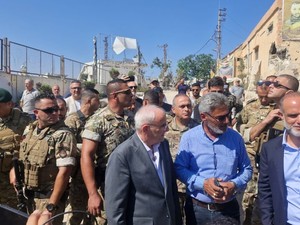
Public Works and Transport Minister Fayez Rasamny and Defense Minister Michel Menassa on Wednesday made a field visit to southern Lebanon, including the towns of Qaqaaiyet al-Jisr and Zawtar al-Gharbiyeh, to assess the extent of damage inflicted by Israel’s attacks on infrastructure, roads and bridges, and to follow up on the implementation steps aimed at repairing them to enable residents to return.
The tour included several neighborhoods in Zawtar al-Gharbiyeh where the Israeli army destroyed most of the houses and severely damaged the infrastructure, particularly the road network.
The two ministers met with residents who had returned to the town, which has become under the protection of army units deployed in its neighborhoods to establish security and remove suspicious objects left behind by the Israeli army. They also observed from a distance the towns and sites occupied by the Israeli army, located within what it calls the "yellow zone."
Following the tour, Rasamny spoke to reporters, stating that the South "paid a heavy price in defense of the homeland, but the will of its people has not been broken, and the state will remain by their side until the reconstruction of what was destroyed is complete."
Rasamny noted that "during the period of aggression, the Cabinet approved an emergency and comprehensive action plan to rehabilitate, open, and maintain damaged roads and rebuild destroyed bridges." He explained that "the Ministry assumed responsibility for reopening main and secondary roads, reconnecting villages, and securing temporary crossings in place of destroyed bridges, ensuring that no town is isolated and that the movement of citizens, ambulances, civil defense, and security forces continues."
He affirmed that "every road we reopen is a return to life, every bridge we rebuild is a bridge between the people and the state, and every wall we repair is protection for the livelihoods, security, and future of citizens," reiterating "the Ministry's commitment to continuing to fulfill its duties until the region fully recovers its infrastructure."
For his part, Menassa said: "Our visit today embodies the state's commitment to extending its authority over all Lebanese territory. This makes us even more determined to prove to the world that the state returns not only through security but also through the concerted efforts of all ministries concerned with providing essential services for the return of citizens to their land.”
“This sacred land, which we will never abandon, is returning to the state to provide all the services and requirements that will expedite the return of residents to their towns and villages," Menassa added.
He added: "The army is always ready to reclaim the land. This land is ours and no one else's. Our goal is one: to reclaim our land. How we will do that is our business, and for that reason, I have left the outcome to the ongoing negotiations. But rest assured that the land of the South will return to its people as long as the army continues its advance in the towns."
“This means that legitimacy exists, and legitimacy, as I said, is not complete except through the combined efforts of all ministries, with the army at the forefront. Zawtar is returning today, and every grain of sand in the south will return to its people. It may take time, but it will return, and no intruder will be allowed there. Hence, it is our duty to reclaim the land and hand it over to its people, who are the most deserving of it to live on, and who, at the same time, demand that the state provide services and assistance,” Menassa said.