
Salam stresses commitment to 'protecting monetary stability, purchasing power of citizens'
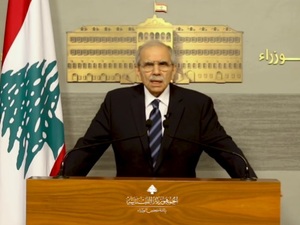
Prime Minister Nawaf Salam on Thursday delivered a speech to the Lebanese people from the Grand Serail, addressing the current economic situation and the challenges facing citizens amid rising prices and living burdens.
Salam began his address by acknowledging the burdens borne by citizens, particularly the increase in private electricity generator bills over the past two months, as well as the pressures imposed by rising fuel prices that force some families to choose between securing fuel and meeting other household needs.
He explained that certain factors affecting prices, such as global oil prices, fall outside the government’s control. He however noted this does not absolve it of its responsibilities and duties toward its citizens.
Salam announced that "the government is working in cooperation with the Ministries of Energy and Finance on sustainable solutions for the electricity sector, aiming to increase power supply and secure it regularly at a lower cost, with additional details to be announced in the coming weeks."
He also declared "allocating funds in the 2027 draft budget for the Public Corporation for Housing to provide loans for families to purchase solar energy systems, reducing their reliance on private generators and lowering monthly bills."
On the public transit front, Salam revealed "the preparation of a comprehensive public transportation plan between regions and within major cities, which includes more than 250 new buses to provide a lower-cost means of transport and ease traffic congestion, with the Minister of Public Works and Transport set to announce its details before the end of next week."
On the economic front, Salam revealed that the Lebanese economy grew by 4.2 percent last year after years of decline, forming the beginning of a recovery and an opportunity to build upon. However, the Israeli war on Lebanon halted this trajectory and set the economy back, Salam said, noting that the estimated economic contraction for the current year stands at 6.4 percent.
He stressed the necessity of preventing certain generator owners, merchants, and importers from exploiting rising costs to generate illicit profits at the expense of citizens, whether through unjustified price increases or by imposing additional charges.
Salam also emphasized that any drop in import or transportation costs must be reflected in the prices of goods and services, rejecting the continuation of elevated price levels after costs have decreased.
Regarding the draft budget for 2027, Salam explained that its expansion to approximately $7 billion reflects a significant improvement in the state's capacity to finance its projects and services. However, he noted that this does not imply a financial surplus sufficient to meet all legitimate citizen needs.
Salam also underscored the government's commitment to “protecting monetary stability and the purchasing power of citizens,” stressing that it will not spend money it does not possess and will work to optimize revenue usage toward priorities that matter to citizens.
Regarding taxes, Salam confirmed that the 2027 draft budget does not introduce any new taxes, contrary to rumors. He clarified that modifications were limited to certain fees that were still calculated at outdated exchange rates, along with new fees targeting yachts and private jets.
He revealed that the Ministry of Finance has begun prosecuting companies evading Value Added Tax (VAT) payments, having issued warnings to 107 companies, while additional files involving estimated sums between $200 million and $250 million remain under review, with preparations underway to issue a new batch of warnings.
He explained that the VAT being pursued from these companies is not a new tax, but rather funds already paid by citizens when purchasing goods and services, which companies collected without remitting to the state treasury.
He stressed that it is unacceptable for these funds to remain with companies at a time when hospitals, schools, and public administrations urgently require funding.
As for corporate profit tax, Salam announced that the government has decided to start with large corporations, noting that 64 major companies currently have their files under review and audit after the administration organized the workload by sector.