
US greenlights Iraqi cabinet with blacklisted factions
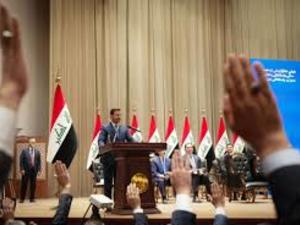
Iraq's prime minister completed his cabinet line-up by appointing a U.S.-designated terrorist after receiving Washington's approval, in a bid to advance efforts to disarm Iran-backed groups in the country, diplomatic sources told AFP.
On Thursday night, Zaidi announced the completion of his government, appointing Laith al-Khazali, a senior leader in the U.S.-blacklisted Asaib Ahl al-Haq group, as one of his deputies.
Prime Minister Ali al-Zaidi "secured tacit U.S. approval during his visit to the United States in September" for the U.N. General Assembly, and during which he met President Donald Trump, a diplomatic source said on Friday.
The U.S. agreed to the participation of some pro-Iran factions in the government "after the prime minister promised to move forward with his disarmament plans and provided guarantees that the groups will not attack U.S. interests in Iraq", the source added.
The U.S., which wields significant influence in Iraq, "wants to help him advance his plans".
Khazali and his brother Qais, the leader of Asaib Ahl al-Haq, are both designated as "global terrorists" by Washington, which sees them as "violent proxies" of Iran.
But their group has emerged as a major political force, winning 27 seats in the latest parliamentary elections.
It was among the first to back Zaidi's plan to bring all arms under state control, says it has begun handing over its own weapons, and has not been publicly linked to recent attacks on US interests.
- Ex-detainees -
Washington accuses the Khazali brothers, both former U.S. detainees, of attacks on its forces after the 2003 invasion of Iraq, including a 2007 attack that led to the capture and killing of five American soldiers.
A second diplomatic source confirmed that the U.S. had given Zaidi the green light to complete his government with the participation of some factions.
One such faction, the Iran-backed Kataeb Sayyid al-Shuhada, part of the Islamic Resistance in Iraq that has recently claimed hundreds of attacks on U.S. interests, secured the tourism ministry.
The U.S. has previously turned a blind eye to the participation of some blacklisted factions in Iraqi governments.
But, this time the shift came after months of mounting pressure on Zaidi to disarm Iran-backed groups, which have long targeted U.S. interests in Iraq and stepped up their attacks during the Middle East war in support of Tehran.
"Things changed," the first diplomatic source said, adding that the U.S. had already shown in Syria its willingness to shift tactics, with its support for Syrian President Ahmed al-Sharaa, who was previously designated a terrorist.
Zaidi, who assumed office earlier this year with U.S. blessing, initially set September 30, the date marking the end of the U.S.-led coalition mission in Iraq, as the deadline for factions to hand over their weapons.
He later withdrew it as talks continued, and then set a new deadline of June 30.
Zaidi announced part of his cabinet in May, but the remaining portfolios were held up by negotiations among political parties, including demands from some factions for government representation.