
Dockworkers stage international strikes to denounce arms shipments, demand better conditions
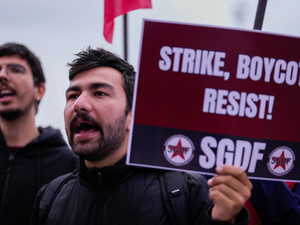
Dockworkers in Europe and beyond were staging strikes on Friday as part of an international campaign against arms shipments and to demand better working conditions, unions said.
Unions in France, Italy, Greece, Spain, Turkey and Morocco issued a joint call to demand an end to the wars in the Middle East, including the war in Gaza, and "an end to the militarization of ports."
"Ports must not be used for the transport of weapons, ammunition, military equipment and troops," the statement said. "Dockworkers do not work for war!"
Organizers say more than 100 ports across multiple countries joined the protest movement that could affect port operations in parts of Europe, the Mediterranean region and North America.
In Greece, the ENEDEP dockworkers' union has called for a strike at Piraeus, the country's largest port, as part of the international day of action. In addition, ships remained docked at several ports, disrupting ferry services, because of a separate seafarers' strike demanding better pay, working conditions and improved safety measures.
In Istanbul, Turkey, protesters gathered outside Haydarpasa port beneath a banner reading: "No to war, no to armament!"
Italy's Unione Sindacale di Base (USB) said port demonstrations were planned in key ports, including Genoa, Trieste and Gioia Tauro, coinciding with a nationwide general strike called by major unions to protest rising living costs, low wages and military spending.
France's CGT ports and docks federation has called a one-day strike in major ports including Le Havre, Marseille, Dunkirk and Rouen to reject "the militarization of port facilities" under European policies and denounce the French government's budget proposals, which the union says threaten social protections.
The scale of the disruption remained unclear. Organizers say participation will range from full-day strikes to shorter walkouts and demonstrations.
Supply chain management company C.H. Robinson issued an advisory to its clients that "operational disruptions and shipment delays may occur at participating ports, with the duration and severity expected to vary by port, terminal, and level of local participation."
Experts said they expect the impact on the global supply chain to be limited.
Marcus Baker, global head of marine, cargo and logistics for insurance broker and risk adviser Marsh, said a 24-hour strike is unlikely to cause a material disruption to global trade flows, although it could affect perishable goods and time-sensitive shipments.
But it "adds another layer of complexity to supply chains already under pressure from geopolitical tensions in the Middle East, climate-related events, including El Niño, restrictions affecting the Rhine and the Panama Canal, and shifting tariff regimes," he said.
Judah Levine, head of research for online shipping marketplace Freightos, said at ports such as Genoa, where vessels are already waiting one to two days for a slot, the strike could exacerbate congestion.
Ed Anderson, a professor of supply chain and operations management for the McCombs School of Business at the University of Texas, said the protest movement was not expected to cause outright shortages. "Just one day is not that much in terms of disruption," he said.