
World Bank official says Lebanon slow to act on reconstruction
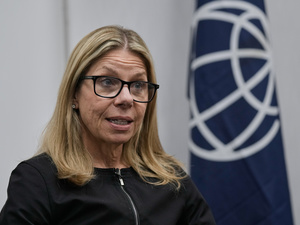
Lebanon has been slow to use international assistance to rebuild areas battered by two recent wars, a top World Bank official told The Associated Press.
The international financial institution approved $250 million in June 2025 to help Lebanon clear rubble and repair "damaged critical public infrastructure" after a bruising 2024 war between Israel and the Iran-backed Lebanese militant group Hezbollah.
The World Bank initially projected that $100 million would be disbursed by July 2026, but a September progress report showed that only $4.2 million had been paid out.
"I think we have to be honest and say it's slower than where we want it to be," World Bank Managing Director of Operations Anna Bjerde said Tuesday during a trip to Lebanon, including visits to war-damaged areas in the south.
She said security issues had contributed to the delays but that the World Bank wants to see the work go more quickly.
Even the full $250 million would cover only a fraction of Lebanon's reconstruction needs.
The World Bank estimated that rebuilding after the 2024 war would cost about $11 billion. Another Israel-Hezbollah war, which broke out in March, caused further destruction, and the Israeli military now occupies a large swath of southern Lebanon. A ceasefire has held in other parts of the country since late June.
Overstretched institutions and security problems delay work
Bjerde said that "institutions in Lebanon are very thinly stretched" after years of crises and the security situation has required "very careful planning around where you can start and where you don't start" to remove rubble and repair infrastructure.
The World Bank needs to be "insistent" and "very close to monitoring on a daily basis" to make sure the work gets done, she said, "because you cannot let the people down."
The office of Lebanese Prime Minister Nawaf Salam said in a statement, "Parliament ratification of the said loan experienced considerable delays and the worsening security situation due to the conflict with Israel delayed the timely launch of project activities."
It said Lebanon's Council for Development and Reconstruction has taken measures to speed up implementation and that $70 million worth of projects are expected to be launched by the end of the year.
At the height of the latest war, more than 1 million people were displaced in Lebanon. About 300,000 remain unable to return home.
Hezbollah has accused Lebanon of failing to carry out its duties to help the displaced. Last month, the group announced it will pay up to $14,000 to families whose homes were destroyed or made uninhabitable during the war with Israel.
U.S. officials have said that large-scale reconstruction aid is contingent on the militant group's disarmament, but that is not a condition for the World Bank assistance.
Iran war's effects ripple across the region
Bjerde also visited Syria on Wednesday, where hopes that Gulf money would help fund reconstruction after nearly 14 years of civil conflict have been dashed by the regional war that began when the U.S. and Israel attacked Iran on Feb. 28.
The war has disrupted energy exports through the Strait of Hormuz, and Iran has fired missiles and drones at Gulf countries hosting U.S. bases. In normal times, 20% of the world's oil supply passes through the strait.
The conflict has driven up prices, with 80% of countries worldwide seeing inflation rise this year, Bjerde said. The effects have been felt acutely in the Middle East.
"Lebanon and Syria and the broader region are affected by this conflict, and it's affected by what happens in the Gulf countries," Bjerde said. "Those are a big, big part of the economy in this region."
Since the war began, countries in the region have pushed ahead with plans for transportation and energy networks that would provide alternatives to routes through the strait. These include a rail line connecting Iraq's Basra port to Turkey and an oil pipeline linking Kirkuk in northern Iraq to the ports of Baniyas in Syria and Tripoli in northern Lebanon.
Bjerde said the World Bank had received more requests for help building such "economic corridors" and was conducting "a lot of due diligence" on potential projects.
"This is a new, emerging, large transformative opportunity," she said.
The projects are costly and will require a mix of public and private funding, Bjerde said, "but these are worthwhile investments that can really change a country's opportunity and make a region, a sub-region, an economic unit."